 Dark Horse

Aug. 25, 2026
This blog introduces the Dark Horse 10-Surface AI Visibility Framework—a practical way to assess the public evidence AI systems use to discover, understand, and validate B2B brands.

Picture a CMO who's certain her brand is well known in its category. Analysts cite her company. Customers rave about it on G2. Her team ranks on page one for every keyword that matters.
Then she opens ChatGPT and asks: "What are the best [category] companies for [her exact ICP]?"
Her brand doesn't appear.
This is happening across B2B right now. Buyers use ChatGPT, Gemini, Perplexity, Claude, Microsoft Copilot and Google AI experiences to discover vendors, compare options, validate claims and narrow shortlists — often before they ever visit a website.
That means the question is no longer just:
"Where does my brand rank?"
It is:
"What can AI systems discover about my brand — and does that translate into consistent visibility across AI answer engines?"
Most brands don't know the answer. This audit methodology is designed to find out.
An AI visibility audit is more than a technical SEO audit, a media audit, an LLM prompt test or a fixed list of websites that "train the models."
Modern AI answers are influenced by a combination of:
So the most useful way to assess AI visibility is to separate inputs from outcomes.
Part I — Evidence Readiness
Audit the 10 public surfaces that shape how AI systems discover, understand and validate a brand.
Part II — AI Visibility Performance
Measure whether that evidence actually translates into accurate, consistent visibility across major AI answer engines.
The logic is simple:
10 observable evidence surfaces in. AI visibility out.
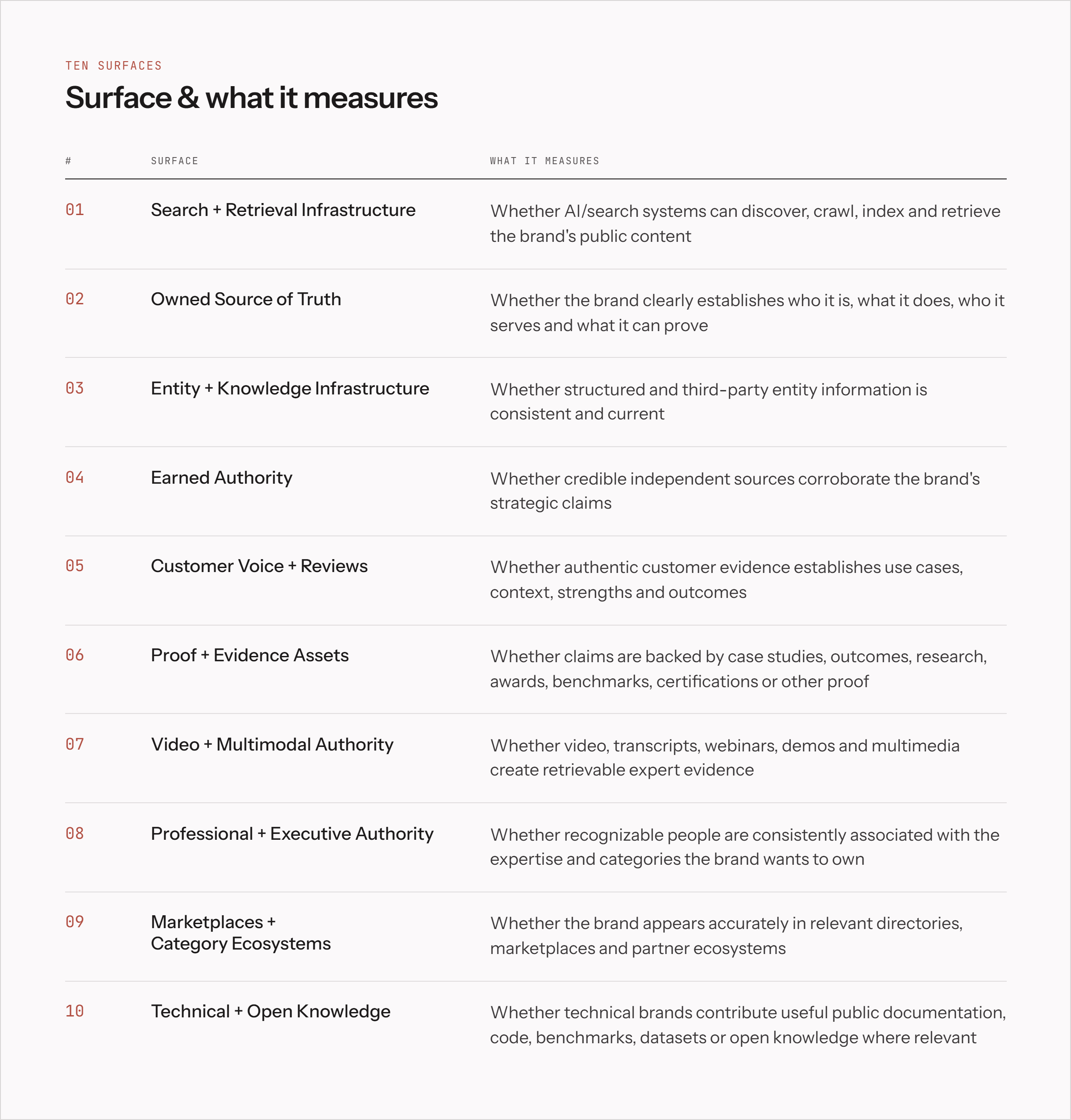
Not every surface should carry equal weight for every company. A cybersecurity platform may have a highly relevant Technical + Open Knowledge surface. A professional services firm may not. A SaaS company may depend heavily on G2 and marketplaces. An agency may depend more on Clutch, earned authority, proof and executive visibility. The framework should reflect the actual buyer journey rather than forcing every brand into the same channel mix.
Step 1: Define the buyer journeys you want to test
The audit is only as good as the prompts behind it. But do not think of this as a list of 25 fixed questions. A better methodology starts with six buyer jobs:
Discover
Qualify
Compare
Validate
De-risk
Decide
For the highest-priority buyer journeys, use more than one wording variation. A brand that appears only when the question is phrased in one very specific way does not have resilient visibility.
Step 2: Build a controlled AI Visibility Performance panel
Now test the outcome layer. Run the same core prompt set across the AI environments most relevant to your buyers:
For every prompt-engine run, record:
Do not treat answer order as a stable search ranking. A single response is a sample. For a standard client audit, run priority prompts more than once and test at least two semantically equivalent wording variants for the most important discovery and comparison questions.
Mention Rate
Recommendation Rate
Prompt Resilience
Cross-Engine Coverage
Cross-Engine Consistency
Discovery Gap
Step 3: Audit Search + Retrieval Infrastructure
Ask whether relevant public information can actually be found and retrieved.
Core question: If an AI retrieval system needs evidence about this company, can it get to the right information easily?
Do not assume that a page-one search rank automatically determines AI inclusion. Search ranking and AI retrieval overlap, but they are not the same thing.
Step 4: Audit the Owned Source of Truth
Your website should contain the clearest, most current version of the company's story.
The problem is often not lack of content, it is lack of extractable clarity. A site can contain thousands of words and still force AI systems to infer what the company actually does. The strongest owned content makes important claims explicit.
Step 5: Audit Entity + Knowledge Infrastructure
Now test whether the broader web agrees with the brand's own story.
Ask whether the same important facts remain consistent: brand name, category, description, ownership, leadership, acquisitions and core offerings. For acquired or rebranded companies, this is often where AI confusion begins.
Step 6: Audit Earned Authority
The question here is: “Do credible independent sources corroborate the claims the brand wants buyers and AI systems to believe?”
Start by identifying the five to ten most important brand associations. A large volume of press coverage can still produce weak AI positioning if the coverage is about funding, executive hires or generic company news rather than the category the brand wants to own.
Step 7: Audit Customer Voice + Reviews — without false negatives
This is where automated audits often break. A failed search does not mean a footprint is absent.
A brand may have hundreds of Gartner Peer Insights reviews, strong G2 category presence, current Capterra visibility, analyst/customer recognition and relevant product-level pages — and still be incorrectly reported as “missing” if the audit relies on one generic search path.
So use a verification ladder:
Then classify the result as:
Only Verified Absent should receive a true zero.
Not found is not absent.
Step 8: Audit Proof + Evidence Assets
Now ask: Can the brand substantiate the claims it makes?
Then calculate a simple Claim-to-Proof Ratio: priority strategic claims supported by discoverable evidence ÷ priority claims tested.
A brand with strong messaging but little discoverable proof is vulnerable. A brand with strong proof but poor retrieval may have a visibility translation problem instead. Those require very different fixes.
Step 9: Audit Video + Multimodal Authority
Video now deserves its own surface, which now includes:
The key question is whether video content creates a useful machine-readable layer around expert knowledge.
Strong video assets typically have descriptive titles, clear speakers/expert identity, transcripts, captions, chapters, factual density, examples and proof, and consistent brand/category language.
Step 10: Audit Professional + Executive Authority
Do not reduce this to follower count or posting frequency. Look for whether important people are consistently associated with the expertise the company wants to own.
Person → Expertise → Topic → Company
A high-volume social presence with little category substance is less valuable than consistent expert evidence across multiple credible environments.
Step 11: Audit Marketplaces + Category Ecosystems
This surface is category-dependent, but could include:
Do not penalize a brand for being absent from an ecosystem that does not matter to its buyers. But where a marketplace does matter, assess category placement, taxonomy, description accuracy, proof, reviews, stale or duplicate profiles, and acquisition/rebrand fragmentation.
Step 12: Audit Technical + Open Knowledge where relevant
This is another conditional surface, but for the right-fit technology brands should include:
For nontechnical brands, this may legitimately not be applicable. Do not manufacture an empty GitHub repository because someone said it helps GEO. The value comes from publishing real, useful knowledge.
Step 13: Build the Surface Evidence Census
Before assigning scores, create an inventory of what you actually verified. This prevents an automated audit from confusing its own retrieval limitation with the brand's actual footprint.
Evidence Discovery Confidence
How confidently could the audit verify the data?
Footprint Strength
How substantial is the brand's actual verified presence?
A source can have Medium discovery confidence + very high footprint strength. Do not punish the brand because the audit system encountered a login wall.
Step 14: Score Evidence Readiness
Score each applicable surface across five dimensions:
Accessibility
Can relevant systems reach the evidence?
Clarity
Does the evidence clearly establish the intended entity or claim?
Authority
Is the source credible for that claim?
Corroboration
Do independent sources reinforce the same conclusion?
Freshness
Is the evidence current?
Do not score an Unverified / Inaccessible source as zero. Flag it for verification. And do not force every surface to carry equal weight.
Step 15: Interpret Evidence Readiness against AI Visibility
Now bring the two halves together.
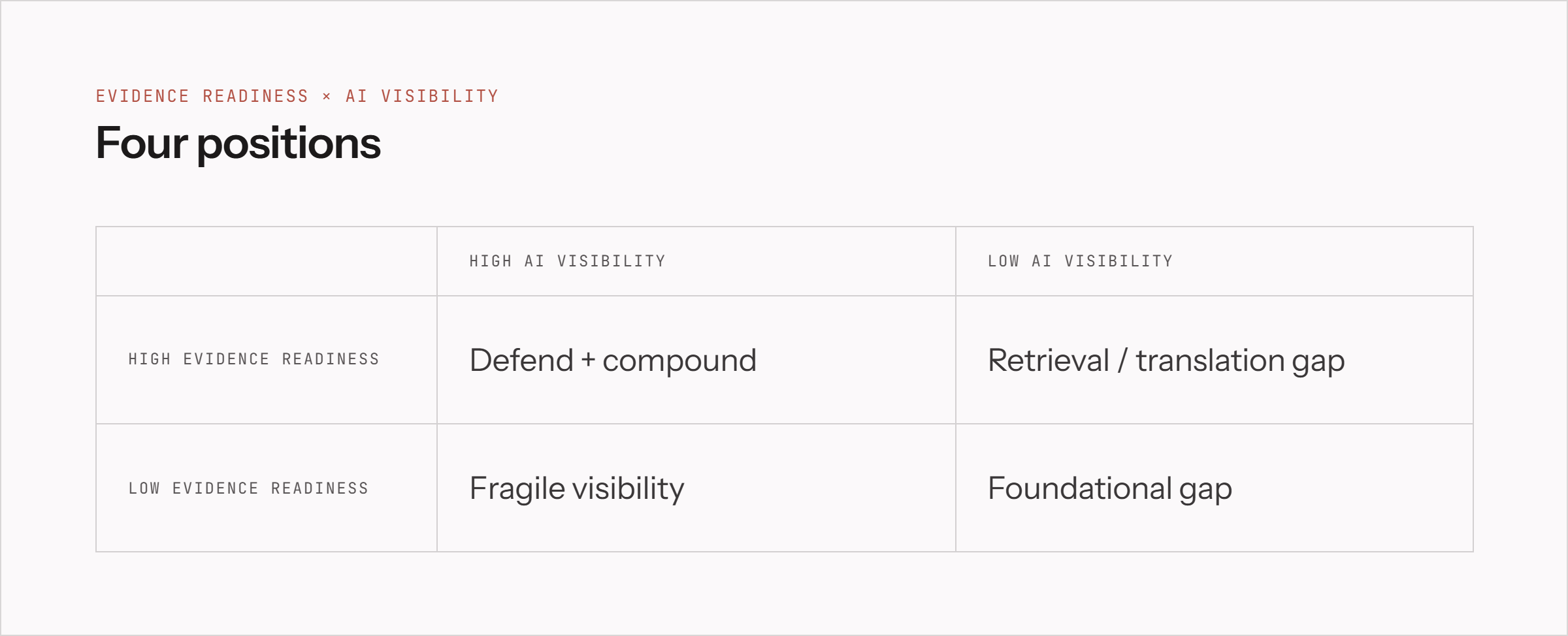
High Evidence + High Visibility
The system is working. Protect and compound it.
High Evidence + Low Visibility
The brand has the proof but AI systems are not consistently surfacing it. Investigate retrieval, source selection, entity clarity and prompt resilience.
Low Evidence + High Visibility
The brand is visible, but the position may be fragile. Strengthen corroboration before competitors displace it.
Low Evidence + Low Visibility
The brand has a foundational evidence problem. Fix the source environment first.
Common patterns and what they mean
Pattern 1: Strong owned content, weak earned corroboration
AI understands the brand when explicitly named but rarely introduces it in category discovery.
Likely issue: Discovery Gap.
Fix: Build credible third-party evidence around the categories and use cases the brand wants to own.
Pattern 2: Strong proof, inconsistent entity data
AI knows the company but describes it differently across engines.
Likely issue: Entity inconsistency.
Fix: Reconcile ownership, acquisition, product, leadership and category descriptions across high-authority sources.
Pattern 3: Strong review footprint, audit initially reports absence
The brand has a large footprint, but the automated audit fails to retrieve it.
Likely issue: Verification failure, not brand weakness.
Fix: Run source-specific verification using product names, market categories, aliases, licensed reports and gated-source rules before scoring.
Pattern 4: High branded visibility, weak unbranded discovery
AI can answer “What is Brand X?” but does not introduce Brand X when buyers ask for recommendations.
Likely issue: Large Discovery Gap.
Fix: Strengthen earned authority, category evidence, customer voice and proof around problem-first buyer language.
Pattern 5: Strong AI visibility, weak evidence readiness
The brand frequently appears today, but supporting evidence is thin.
Likely issue: Fragile visibility.
Fix: Strengthen proof and independent corroboration before the recommendation environment changes.
Pattern 6: Strong executive visibility, weak company authority
The CEO is well-known, but the company itself is inconsistently associated with the same expertise.
Likely issue: Person-to-brand translation gap.
Fix: Connect executive expertise to durable owned, earned and proof assets.
What the audit should give you at the end
A strong AI visibility audit should produce more than a surface score. You should leave with:
The objective is to understand the evidence environment from which AI systems form an opinion of your brand — and whether that opinion helps or hurts you during buyer consideration.
That is the new GTM visibility problem, and it is increasingly measurable.
The Dark Horse 10-Surface AI Visibility Framework includes the full methodology, prompt-testing protocol, scoring approach and evidence-verification standard on GitHub.
Megan Kessler is the Founder & CEO of Dark Horse Strategies, an AI-native B2B GTM consultancy specializing in AI-mediated pipeline and visibility strategy.